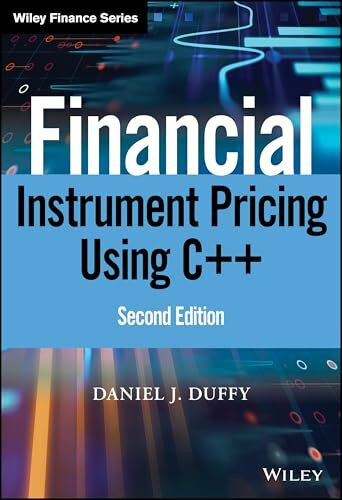
Financial Instrument Pricing Using C++ (Wiley Finance)
Kurzinformation

inkl. MwSt. Versandinformationen
Artikel zZt. nicht lieferbar

Beschreibung
"Financial Instrument Pricing Using C++" von Daniel J. Duffy ist ein umfassendes Werk, das sich mit der Implementierung und Analyse von Finanzinstrumenten mittels der Programmiersprache C++ beschäftigt. Das Buch richtet sich an Finanzingenieure, quantitative Analysten und Entwickler, die sich mit der Modellierung und Bewertung von Derivaten und anderen Finanzprodukten befassen. Duffy kombiniert theoretische Konzepte der Finanzmathematik mit praktischen Programmierlösungen. Er bietet eine detaillierte Einführung in die Grundlagen der C++-Programmierung, bevor er zu komplexeren Themen wie Monte-Carlo-Simulationen, Finite-Differenzen-Methoden und stochastischen Differentialgleichungen übergeht. Ein Schwerpunkt des Buches liegt auf dem Design robuster Softwarearchitekturen für die Preisberechnung von Finanzinstrumenten. Duffy erläutert Best Practices im Software-Engineering und zeigt auf, wie wiederverwendbare und skalierbare Code-Strukturen entwickelt werden können. Durch zahlreiche Beispiele und Übungen ermöglicht das Buch den Lesern, ihr Wissen praktisch anzuwenden und ihre Fähigkeiten in der Entwicklung finanztechnologischer Anwendungen zu vertiefen. Insgesamt dient es als wertvolle Ressource für alle, die sich mit der Schnittstelle von Finanzen und Technologie auseinandersetzen möchten.
Produktdetails

So garantieren wir Dir zu jeder Zeit Premiumqualität.
Über den Autor
DANIEL J. DUFFY started the company Datasim in 1987 to promote C++ as a new object-oriented language for developing applications in the roles of developer, architect and requirements analyst to help clients design and analyse software systems for Computer Aided Design (CAD), process control and hardware- software systems, logistics, holography (optical technology) and computational finance. He used a combination of top-down functional decomposition and bottom-up object-oriented programming techniques to create stable and extendible applications. Prior to Datasim, he worked on engineering and financial applications in oil and gas and semiconductor industries using a range of numerical methods (for example, the finite element method [FEM]) on mainframe and mini-computers. Duffy has BA (Mod), MSc and PhD degrees in pure, numerical and applied mathematics and has been active in promoting partial differential equation (PDE) and finite difference methods (FDM) to applications in computational finance. He was responsible for the introduction of the Fractional Step ("Soviet Splitting") method and the Alternating Direction Explicit (ADE) method in computational finance. He is the originator of two very popular and leading C++ online courses (both C++98 and C++11/14/17) on www.quantnet.com in cooperation with Quantnet LLC and Baruch College (CUNY), NYC. He also trains quants, developers and designers around the world. Duffy can be contacted at [email protected]. In his spare time, he tries to keep in shape by workouts in the dojo.
- Gebunden
- 352 Seiten
- Erschienen 2005
- Springer
- Gebunden
- 352 Seiten
- Erschienen 2014
- De Gruyter Oldenbourg
- Kartoniert
- 400 Seiten
- Erschienen 2021
- Wiley-VCH
- Gebunden
- 360 Seiten
- Erschienen 2011
- Wiley
- Hardcover
- 268 Seiten
- Erschienen 2001
- Jai Press Inc.
- Hardcover
- 496 Seiten
- Erschienen 2018
- Wiley
- Gebunden
- 516 Seiten
- Erschienen 2004
- The MIT Press
- Kartoniert
- 849 Seiten
- Erschienen 2011
- McGraw-Hill Education Ltd
- hardcover
- 364 Seiten
- Erschienen 1988
- Pearson
- Kartoniert
- 156 Seiten
- Erschienen 2009
- De Gruyter Oldenbourg
- paperback
- 496 Seiten
- Erschienen 2001
- Erich Schmidt Verlag
- Hardcover
- 439 Seiten
- Erschienen 2004
- McGraw-Hill Education Ltd
- Kartoniert
- 839 Seiten
- Erschienen 2016
- Schäffer-Poeschel
- hardcover
- 455 Seiten
- Erschienen 2000
- MIT Press