



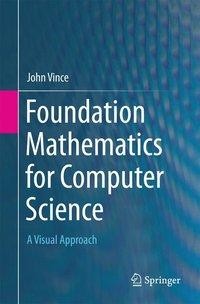
Foundation Mathematics for Computer Science
Kurzinformation


 Handgeprüfte Gebrauchtware
 Schnelle Lieferung
 Faire Preise
inkl. MwSt. Versandinformationen
Artikel zZt. nicht lieferbar
Artikel zZt. nicht lieferbar

Beschreibung
John Vince describes a range of mathematical topics to provide a foundation for an undergraduate course in computer science, starting with a review of number systems and their relevance to digital computers, and finishing with differential and integral calculus. Readers will find that the author's visual approach will greatly improve their understanding as to why certain mathematical structures exist, together with how they are used in real-world applications.Each chapter includes full-colour illustrations to clarify the mathematical descriptions, and in some cases, equations are also coloured to reveal vital algebraic patterns. The numerous worked examples will consolidate comprehension of abstract mathematical concepts.Foundation Mathematics for Computer Science covers number systems, algebra, logic, trigonometry, coordinate systems, determinants, vectors, matrices, geometric matrix transforms, differential and integral calculus, and reveals the names of the mathematicians behind such inventions. During this journey, John Vince touches upon more esoteric topics such as quaternions, octonions, Grassmann algebra, Barycentric coordinates, transfinite sets and prime numbers. Whether you intend to pursue a career in programming, scientific visualisation, systems design, or real-time computing, you should find the author's literary style refreshingly lucid and engaging, and prepare you for more advanced texts.
Produktdetails

So garantieren wir Dir zu jeder Zeit Premiumqualität.
Entdecke mehr vom Verlag


