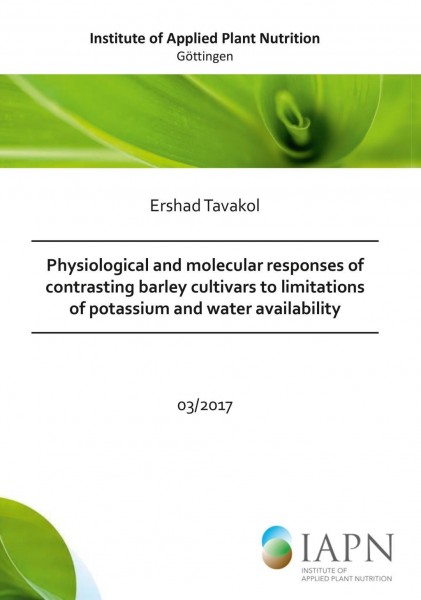
Physiological and molecular responses of contrasting barley cultivars to limitations of potassium and water availability
Kurzinformation


 Handgeprüfte Gebrauchtware
 Schnelle Lieferung
 Faire Preise
inkl. MwSt. Versandinformationen
Artikel zZt. nicht lieferbar
Artikel zZt. nicht lieferbar

Beschreibung
Plants cope with drought stress conditions by adjusting transpiration and simultaneously optimizing their carbon assimilation rates. Continuous stress however, increases compounds known as reactive oxygen species (ROS) being toxic to the plants. One of the key nutrients, which aids the plants under environmental stress, is Potassium (K). It is known that optimization of K supply will mitigate the impacts of osmotic stress via increased stomatal conductance and improved assimilate translocation leading to less ROS production.In this study, we have investigated the impacts of K supply on plant water relations (e.g. water use efficiency WUE, stomatal conductance gs and assimilation AN) under osmotic stress conditions. Moreover, the dynamics of most important ROS (hydrogen peroxide H2O2, and Super oxide O2-) and antioxidants enzymes (catalase CAT, glutathione reductase GR, ascorbate peroxidase APX and super oxide dismutase SOD) were studied. Finally, Massive Analysis of CDNA Ends (MACE) was performed to observe the whole genome transcriptional responses to potassium supply under osmotic stress conditions.K supply had a positive effect on biomass-WUE, AN and gs leading to increased biomass under osmotic stress conditions. Contrarily, when low K supplied plants were treated with osmotic stress, reduced biomass was observed caused by severe ROS damage. Under the latter conditions, high activity of GR and APX was observed; nevertheless, these high activities were not sufficient to detoxify high H2O2 and O2- levels.The whole genome transcriptional response showed that low K supply plants exposed to osmotic stress were subjected to massive whole genome expression in order to resist the stress condition, costing them considerable energy consumption and eventuating in limited yield achievement.It is concluded that potassium supply under osmotic stress mitigated the photo-oxidative damage mainly via improved photosynthesis and avoiding ROS generation rather than high antioxidant activity. Optimization of K nutrient under osmotic stress recovers most of the changes in the metabolism pathways back to control conditions. von Tavakol, Ershad
Produktdetails

So garantieren wir Dir zu jeder Zeit Premiumqualität.
Entdecke mehr vom Verlag