


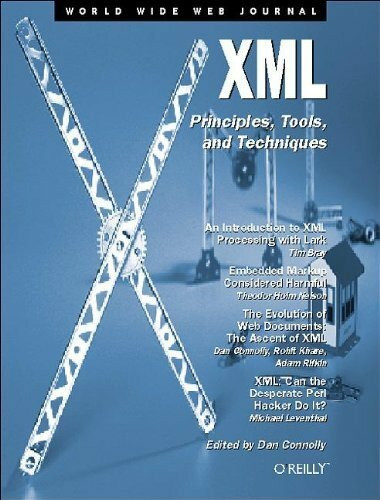
World Wide Web Journal: Principles, Tools, and Techniques
Kurzinformation

 Handgeprüfte Gebrauchtware
 Schnelle Lieferung
 Faire Preise
inkl. MwSt. Versandinformationen
Lieferzeit 1-3 Werktage
Lieferzeit 1-3 Werktage

Beschreibung
The Web is a landmark in the evolution of Internet information systems because its lingua franca allows authors to say what they mean, rather than merely how to say it. W3C's new eXtensible Markup Language (XML) carries that torch forward to a new generation of information services. Whereas HTML limits writers to a common pool of semantic idioms like "This is a top-level heading", XML allows publishers to define their own markup language using application specific meanings. In XML, an invoice isn't limited to boldfaced part numbers and quantity tables -- now, it can use and tags. The shift to XML will unleash a diverse range of new applications. Mathematical equation structures are encoded in XML in W3C's new MathML specification. Databases can be automatically published to the Web, schemas intact. New metainformation systems can document the structure of Web content using the Web. New XML-savvy access protocols can selectively address and download portions of XML documents. New browsers and client tools can animate and script XML's object model with ease. Style sheets can automate rendering decisions for new XML tags, not just on the screen, but for printers, aural output, and beyond. XML is a milestone on the path to building a mirror of the real world's knowledge inside the Web. This issue of the Web Journal is your first look at the technical specifications and early applications of a new data format that will rock every aspect of the Web: markup, linking, and exchange. Guest editor Daniel Connolly, W3C's architecture domain leader, is an ideal guide, having pioneered the very notion of standardizing HTML as an application of SGML (Standardized General Markup Language). This issue includes contributions from the members of the XML Working Group: Jon Bosak, Sun Microsystems (Chair); James Clark (Technical Lead); Tim Bray, Netscape (Co-editor); C. M. Sperberg-McQueen, University of Illinois (Co-editor); Jean Paoli, Microsoft (Co-editor); Steve DeRose, INSO; Dave Hollander, HP; Eliot Kimber, Highland; Tom Magliery, NCSA; Eve Maler, ArborText; Peter Sharpe, SoftQuad; and Murray Maloney (GRIF). Highlights include our major offering, "The Evolution of Web Documents: The Ascent of XML" (Connolly, Khare, Rifkin); "XML: Can the Desperate Perl Hacker Do It" (Michael Leventhal); "Building Microsoft's XML Parsers in IE4" (Paoli, Schach, Lovett, Layman, Cseri); "JUMBO: An Object-Based XML Browser" (Peter Murray-Rust); "An Introduction to XML Processing with Lark" (Tim Bray); and a contrarian position entitled "Inline Markup Considered Harmful" (Ted Nelson).
Produktdetails

So garantieren wir Dir zu jeder Zeit Premiumqualität.


