


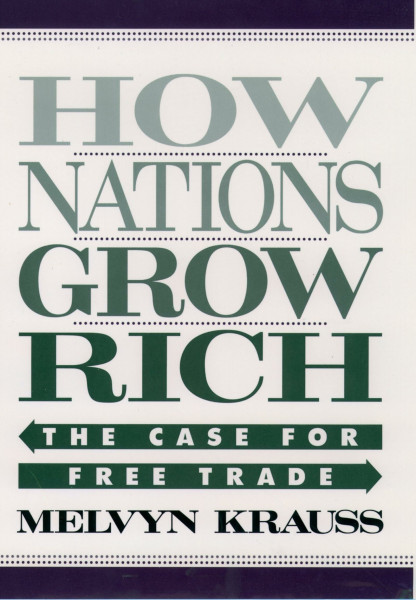
How Nations Grow Rich: The Case for Free Trade
Kurzinformation

 Handgeprüfte Gebrauchtware
 Schnelle Lieferung
 Faire Preise
inkl. MwSt. Versandinformationen
Lieferzeit 1-3 Werktage
Lieferzeit 1-3 Werktage

Beschreibung
There can be no doubt, writes economist Melvyn Krauss, that the prosperity of the industrial nations since the Second World War has been due largely to global specialization and interdependence. No one country does all tasks today -- products are designed in one country, produced in another and assembled in a third. The increased standard of living resulting from global specialization in turn has led to the growth of the modern welfare state, including an increased demand for economic security and social measures which guarantee politically-determined minimum consumption standards for citizens. Ironically, says Krauss, as the debate over the North American Free Trade Area (NAFTA), the General Agreement of Tariffs and Trade (GATT) and the recently established World Trade Organization demonstrate, today's welfare state has evolved into a protectionist state. U.S. consumer advocates (Ralph Nader) see free trade as a threat to consumerist legislation. U.S. environmentalists (Jerry Brown) see free trade as a threat to environmental legislation. U.S. human rights advocates (Anna Quindlin) see free trade as a threat to human rights abroad. In How Nations Grow Rich, Krauss argues there is no inherent reason why the growth of the welfare state in the Western industrial countries should conflict with free trade that is, there is no inherent reason for the welfare state to be protectionist. Exposing fallacious "welfare state" arguments for protection, Krauss makes a powerful case for free trade in general, and NAFTA in particular, as mechanisms for raising U.S. living standards. Americans are made better off through a reallocation of U.S. productive resources from lower-to-higher productivity uses--from textiles to computers, for example. Moreover, by raising wages in Mexico relative to the U.S., Krauss expects NAFTA to help reduce both legal and illegal immigration. Were states like California to reduce their generous social services and affirmative action programs, labor immigration from Mexico would fall to politically acceptable levels. Krauss' novel insight that migration and foreign trade are alternative means of effectuating international exchange is used in this lively and informative book to shed light on a host of important policy issues. By the very act of restricting textile and apparel imports, the U.S. virtually compels foreign textile workers to migrate to the U.S. The European Union's tariff against East European exports provokes a flood of Eastern workers to Western Europe. In How Nations Grow Rich, Krauss dispatches both traditional and newer arguments for protection with unusual verve and clarity. Addressing the belief that protectionism boosts employment, he points out that import restrictions can destroy U.S. jobs when imposed on materials we use as parts. For example, in 1991, Apple and Toshiba suffered a dramatic increase in their production costs as a result of a 63% tariff on imported Japanese flat-panel display screens. This "protect-America" policy backfired, causing these two mega-companies to move their production facilities abroad. In response to protectionist demands that the U.S. close its markets until Japan reduces its trade barriers against U.S. goods--that trade be fair before it can be free--Krauss points out that in a market economy where consumers are kings, only a consumer-based equity standard is valid. Thus what the "fair trade" protectionist argument really comes down to is the nonsensical proposition that because foreign countries damage their consumers by foolish protectionist measures, equity demands the United States follow suit. This wide-ranging and stimulating book clarifies such important and often inaccessible issues as development policy, foreign aid, trade sanctions, child labor, human rights trade linkages, immigration, European Monetary Union and affirmative action trade policies. How Nations Grow Rich is must reading for anyone concerned with public policy and international economics.
Produktdetails

So garantieren wir Dir zu jeder Zeit Premiumqualität.


