


»Das Neue Europa« 1933-1945
Kurzinformation


 Handgeprüfte Gebrauchtware
 Schnelle Lieferung
 Faire Preise
inkl. MwSt. Versandinformationen
Artikel zZt. nicht lieferbar
Artikel zZt. nicht lieferbar

Beschreibung
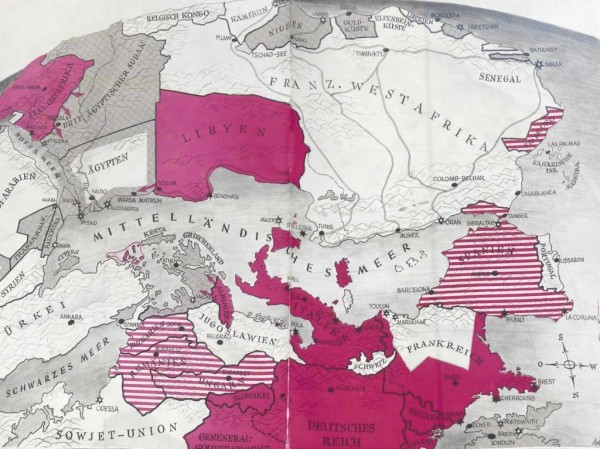
The term Europe has not always been under-stood in the same way. Depending on the period and influenced by the dominant interpreting elites at the time, it was always different features that were emphasised, »new« traditions that were discovered and »created«, and different values - specific to the period - that were claimed as European. Europe is a construct. That is as true today as in the period before 1945. This monograph focuses on »Sachbücher« (nonfiction books), travelogues and literary-political writings by eight authors who played a key role in the discourse on Europe in the Third Reich and also partly in the early German Federal Re-public. One of them is Walter Kiaulehn. In World War II, in the periodical Signal, Kiaulehn draws up a European »family tree« of a somewhat different, totalitarian kind - naturally excluding semi-Asiatic Russia as well as England, »a refugee from Eu-rope«. England has »swum off« in the direction of the USA. For Ernst Wilhelm Eschmann, Great Britain and France belong to the »margins of Eu-rope« anyway, while the central powers, Germany and Italy, constitute the actual core of the continent. Europe evolves from the centre, and it is characteristically medial, balanced, mediating between tradition and progress. It is the others who are radical and have no appreciation for the middle course: the Americans with their skyscraper fantasies and the Bolsheviks with their anti-cultural tabula-rasa mentality. »The New Europe«, on the other hand, is the continent where in accordance with a golden mean that has developed historically, a moderate Modernism takes shape. An instance of this is the »New Bari«, the »favor-ite city of Fascism« that Gustav R. Hocke visits in 1937 and in which, instead of giant high-rises, he encounters much smaller, six-storey buildings along the new waterfront promenade. The term »The New Europe« became generally accepted in Germany during the 1930s, and by the beginning of World War II it was an integral part of the German discourse on Europe. Carl Wege teaches at the University of Biele-feld. His research focuses on the interface of lit-erary studies, historiography and journalism. His most recent book is Buchstabe und Maschine. Beschreibung einer Allianz, published by Suhr-kamp Verlag. At present he is working on a new research project, titled »The construction of a community of values and of a shared destiny. The discourse on Finland in Germany from 1933 to 1945«.
Produktdetails

So garantieren wir Dir zu jeder Zeit Premiumqualität.


