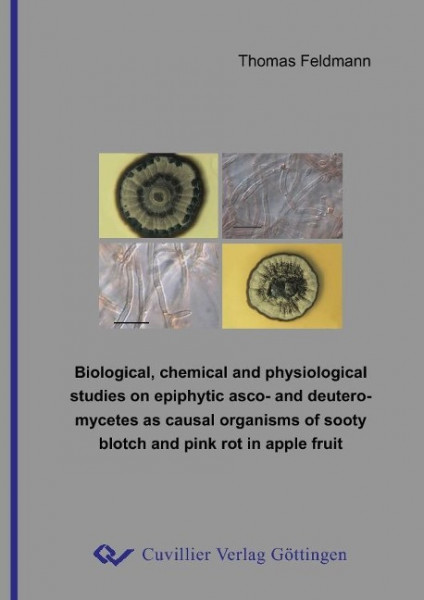
Biological, chemical and physiological studies on epiphytic asco- and deuteromycetes as causal organ
Kurzinformation


 Handgeprüfte Gebrauchtware
 Schnelle Lieferung
 Faire Preise
inkl. MwSt. Versandinformationen
Artikel zZt. nicht lieferbar
Artikel zZt. nicht lieferbar

Beschreibung
Within the scope of this study in Germany isolated causal organisms of sooty blotch of apple could be characterised and classified employing classical mycological, statistical and rDNA analytical methods. Furthermore, it was clarified by analyses on basis of HPLC/MS/MS, if cultures of these fungal pathogens, infested and inoculated apples as well as apple products are contaminated with mycotoxins belonging to the group of trichothecenes. In addition, it was verified in agar plate tests, in how far certain stressors may influence mycotoxin production and growth of Trichothecium roseum selected as model fungus. The following questions were answered in the present study: 1. What are the mycological and morphological characters of the pathogens of the sooty blotch disease? In the present study the in vitro characters of sooty blotch isolates from Germany were examined in detail. In addition to the use of classical-mycological methods a statistical analysis of the in vitro characters of the respective taxa was carried out. On the basis of these analyses it was differentiated between 11 taxa. Some of them could be definitely identified: Peltaster fructicola, Phialophora sessilis, Tripospermum camelopardus and Tripospermum myrti. Some taxa showed very special characters. Phialophora sessilis is characterised by brown attached collarettes, taxon II is forming bulbils, taxon III is forming very thin hyphae with a characteristic content, which reminds of pearl strings ("pearl string type"), and taxon IV has large micro- and macroconidia. Tripospermum camelopardus originally was described to occur in foam of sweet water creeks and now was also detected in our study on a plant surface. A high correlation between closely allocated ribs of the colonies in vitro and the pearl string type of the hyphae was verified. This shows that not only content of hyphae often neglected in descriptions is of eminent importance, but also the formation of the ribs of the colonies can be highly specific for the respective fungal species.
Produktdetails

So garantieren wir Dir zu jeder Zeit Premiumqualität.
Entdecke mehr vom Verlag