



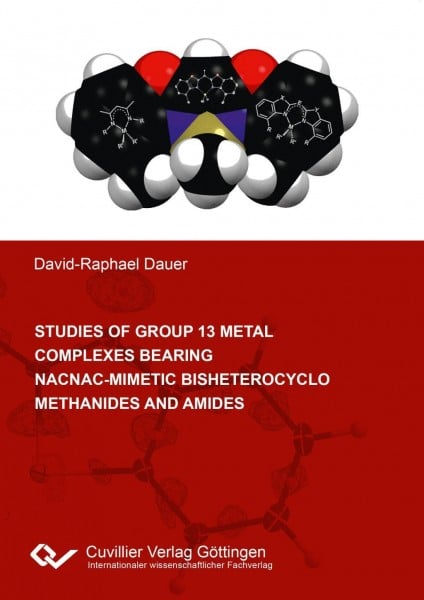
Studies of group 13 metal complexes bearing nacnac-mimetic bisheterocyclo methanides and amides
Kurzinformation

 Handgeprüfte Gebrauchtware
 Schnelle Lieferung
 Faire Preise
inkl. MwSt. Versandinformationen
Artikel zZt. nicht lieferbar
Artikel zZt. nicht lieferbar

Beschreibung
The omnipresent monoanionic nacnac ligand enables the stabilisation of main group elements in low oxidation states and is used as supporting ligand in several catalytical applications. Referring to the nacnac ligand¿s advantages, in the context of this work new ligand systems should be exploited mimicking those electronic and steric properties. The desired parent bisheterocyclo methane and amine ligand platforms are consisting of two benzannulated 1,3-azoles, which are C2-connected via either a methylene or an amine spacer. In comparison to the paragon nacnac ligand, formally the imine substituents are fixed to the backbone of the ligand by building up an additional five-membered heterocycle, containing either oxygen or sulfur atoms as additional donor sites. The bridge¿s protons can easily be abstracted by reaction with the corresponding group 13 metalorganic reagents to form the monoanionic species, carrying the remaining metal fragment. In analogy to the nacnac ligands, also a coordination motif for the metallated species is expected, wherein the metal centre is chelated by two endocyclic nitrogen donors of the trans-trans aligned ligand. For future research on corresponding low-valent metallylenes based on these ligand systems, a screening for suitable derivatives and precursors will be approached, wherein the screening involves the variation of the heterocycles, the bridging moiety and the coordinated metal fragments. Thus, the desired bisheterocyclo methanide and amide complexes should achieve the best from two worlds: the stabilisation abilities for future low-valent metal complexes and the reactivity of group 13 metals. von Dauer, David-Raphael
Produktdetails

So garantieren wir Dir zu jeder Zeit Premiumqualität.
Entdecke mehr vom Verlag


![Synthese von 3-Methoxycarbonyl-6-methyl-bicyclo[4.3.0]nonadien-7,9-on-2, Perhydrocyclopentano-[b]-furanen und Perhydrobenzofuranen](https://d3k2uuz9r025mk.cloudfront.net/media/image/84/8e/e4/dummyHvESjfpINZhPW.jpg "Synthese von 3-Methoxycarbonyl-6-methyl-bicyclo[4.3.0]nonadien-7,9-on-2, Perhydrocyclopentano-[b]-furanen und Perhydrobenzofuranen")


