Improving Crop Productivity in Sustainable Agriculture
Diese Beschreibung wurde mittels künstlicher Intelligenz generiert
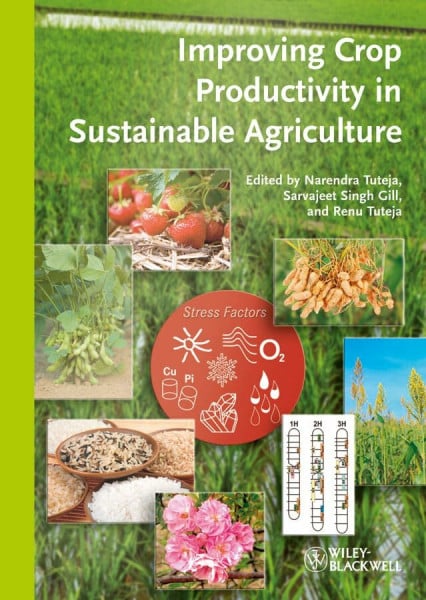
"Improving Crop Productivity in Sustainable Agriculture" von Renu Tuteja ist ein Fachbuch, das sich mit den Herausforderungen und Lösungen zur Steigerung der Ernteerträge im Kontext einer nachhaltigen Landwirtschaft befasst. Das Buch untersucht verschiedene innovative Techniken und Ansätze, die darauf abzielen, die Produktivität landwirtschaftlicher Nutzpflanzen zu erhöhen, ohne dabei die Umwelt zu belasten. Dazu gehören unter anderem fortschrittliche Pflanzenschutzmethoden, effiziente Bewässerungstechniken und der Einsatz biotechnologischer Verfahren. Tuteja legt besonderen Wert auf integrierte Anbaumethoden, die sowohl ökologische als auch ökonomische Aspekte berücksichtigen. Durch Fallstudien und wissenschaftliche Analysen bietet das Buch wertvolle Einblicke für Landwirte, Agrarwissenschaftler und politische Entscheidungsträger, die an der Schnittstelle von Landwirtschaft und Umweltschutz arbeiten.
Dr. Narendra Tuteja did his M.Sc., Ph.D and D.Sc. in Biochemistry from the Lucknow University in 1977, 1982 and 2008, respectively. He is fellow of the Academies of Sciences: FNASc. (2003), FNA (2007), FASc. (2009) and FNESA (2009).
Dr. Tuteja has made major contributions in the field of plant DNA replication and abiotic stress signal transduction, especially in isolating novel DNA/RNA helicases and several components of calcium and G-proteins signaling pathways. Initially he made pioneer contributions in isolation and characterization of large number of helicases from human cells while he was at ICGEB Trieste and published several papers in high impact journals including EMBO J. and Nucleic Acids Research. From India he has cloned the first plant helicase (Plant J. 2000) and presented the first direct evidence for a novel role of a pea DNA helicase (PNAS, USA, 2005) in salinity stress tolerance and pea heterotrimeric G-proteins (Plant J. 2007) in salinity and heat stress tolerance. Dr. Tuteja has reported the first direct evidence in plant that PLC functions as an effector for Ga subunit of G-proteins. All the above work has received extensive coverage in many journals, including Nature Biotechnology, and bulletins all over the world. His group has also discovered novel substrate (pea CBL) for pea CIPK (FEBS J. 2006). He has already developed the salinity tolerant tobacco and rice plants without affecting yield. Recently, few new high salinity stress tolerant genes (e.g. Lectin receptor like kinase, Chlorophyll a/b binding protein and Ribosomal L30E) have been isolated from Pisum sativum and have been shown to confer high salinity stress tolerance in bacteria and plant (Glycoconjugate J. 2010; Plant Signal. Behav. 2010). Recently, very high salinity stress tolerant genes from fungus Piriformospora indica have been isolated and their functional validation in fungus and plants is in progress. Overall, Dr. Tuteja?s research uncovers three new pathways to plant abiotic stress tolerance. His results are an important success and indicate the potential for improving crop production at sub-optimal conditions.
Dr. Sarvajeet Singh Gill did his B.Sc. (1998) from Kanpur University and M.Sc. (2001, Gold Medalist), M. Phil. (2003) and Ph.D (2009) from Aligarh Muslim University.
Dr. Gill has several research papers, review articles and book chapters to his credit in the journals of national and international repute and in edited books. He has co-edited four books namely Sulfur assimilation and Abiotic Stress in Plants; Eutrophication: causes, consequences and control; Plant Responses to Abiotic Stress, and Abiotic Stress Tolerance published by Springer-Verlag (Germany), IK International, New Delhi, and Bentham Science Publishers, respectively. He was awarded Junior Scientist of the year award by National Environmental Science Academy New Delhi in 2008.
Presently with Dr. Tuteja, Dr. Gill is working on heterotrimeric G proteins and plant DNA helicases to uncover the abiotic stress tolerance mechanism in rice. The transgenic plants overexpressing heterotrimeric G proteins and plant DNA helicases may be important for improving crop production at sub-optimal conditions.





 Handgeprüfte Gebrauchtware
 Schnelle Lieferung
 Faire Preise