


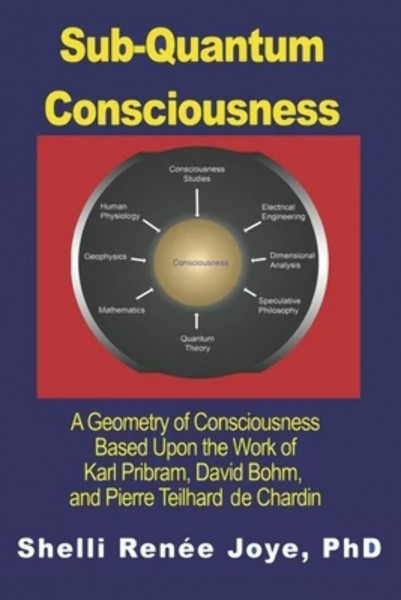
Sub-Quantum Consciousness: A Geometry of Consciousness Based Upon the Work of Karl Pribram, David Bohm, and Pierre Teilhard De Chardin
Kurzinformation


 Handgeprüfte Gebrauchtware
 Schnelle Lieferung
 Faire Preise
inkl. MwSt. Versandinformationen
Artikel zZt. nicht lieferbar
Artikel zZt. nicht lieferbar

Beschreibung
A holoflux theory of consciousness as energy is hypothesized and shown to support both local and non-local properties. This thesis emerges from an integral evaluation of evidence drawn from three sources: (1) the holonomic mind/brain theories of Karl Pribram, (2) the ontological interpretation of quantum theory by David Bohm, and (3) the hyperphysics of consciousness developed by Pierre Teilhard de Chardin. Applying an integral methodology to superimpose and correlate seemingly disparate concepts from among these sources and others, a composite theory emerges, a “holoflux” theory of consciousness, after the term favored by Karl Pribram to describe David Bohm’s “holomovement.” This Pribram–Bohm composite holoflux theory is shown to be congruent with established principles of physics, mathematics, and electrical engineering, as well as with what Pierre Teilhard de Chardin termed “hyperphysics.”Extending the panpsychist paradigm that consciousness is inherent in the structure of the universe, the thesis describes a dynamic energy process bridging the explicate space–time domain with a transcendent flux domain located at the spatial center, everywhere. This center is hypothesized to be synonymous with three key concepts: Karl Pribram’s “flux domain,” David Bohm’s “implicate order,” and Pierre Teilhard de Chardin’s “point Omega.”Commonly held arguments, both philosophical and technical, dismissive of energy fields as a possible substrate of consciousness, are examined and refuted. Major theories of consciousness developed by Pribram, Bohm, and Teilhard de Chardin are examined in detail, and presented in the context of their life experiences. Extending their theories, the holoflux theory of consciousness views reality as one energy, cycling mathematically, lens-like, in a process of transformation manifesting in three modes: (1) electromagnetic energy in space–time, (2) holoflux energy in a transcendent order, and (3) vibrating isospheres at the boundary gap separating the implicate from the explicate orders.Pierre Teilhard de Chardin’s more technical concepts (f, centro-complexity, radial energy, tangential energy, complexity-consciousness, noogenesis, centrology, and Omega) are evaluated in detail, and interpreted within the framework of holoflux theory, to provide new insights into his hyperphysics of centro-complexity. The plausibility of this holoflux theory is examined through identification of correlations between physiological, electromagnetic, and geophysical measurements.
Produktdetails

So garantieren wir Dir zu jeder Zeit Premiumqualität.


