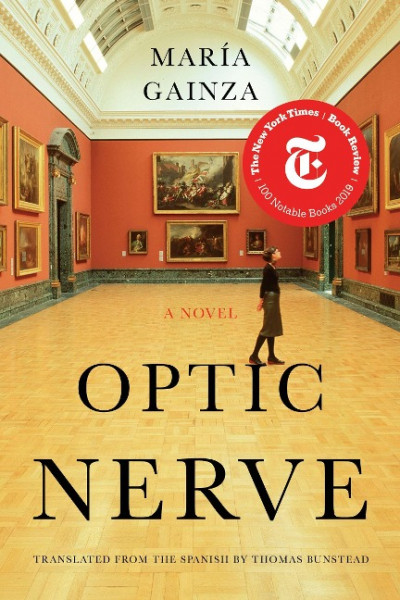
Optic Nerve
Kurzinformation
inkl. MwSt. Versandinformationen
Artikel zZt. nicht lieferbar

Beschreibung
The U.S. debut novel of a celebrated Argentinian author-named a finalist for the Premio Dulce Chacon-blending fiction, history, and personal essay to tell the story of one woman's obsession with art von Gainza, Maria und Bunstead, Thomas
Produktdetails
So garantieren wir Dir zu jeder Zeit Premiumqualität.
Über den Autor
María Gainza was born in Buenos Aires, where she still resides. She has worked as a correspondent for The New York Times in Argentina, as well as for ARTnews. She has also been a contributor to Artforum, The Buenos Aires Review, and Radar, the cultural supplement from Argentine newspaper Página/12. She is coeditor of the collection Los Sentidos (The Senses) on Argentinean art, and in 2011 she published Textos elegidos (Selected Texts), a collection of her notes and essays on contemporary art. Optic Nerve is her first work of fiction and her first book to be translated into English.Thomas Bunstead is a writer and translator based in East Sussex, England. He has translated some of the leading Spanish-language writers working today, including Eduardo Halfon, Yuri Herrera, Agustín Fernández Mallo, and Enrique Vila-Matas, and his own writing has appeared in publications such as Kill Author, The White Review, and The Times Literary Supplement. He is an editor at the translation journal In Other Words.
- Gebunden
- 1349 Seiten
- Erschienen 2018
- De Gruyter
- hardcover
- 504 Seiten
- Erschienen 1997
- Oxford University Press
- Kartoniert
- 364 Seiten
- Erschienen 2009
- Springer Berlin Heidelberg
- Gebunden
- 1000 Seiten
- Erschienen 2006
- Springer
- hardcover
- 304 Seiten
- Erschienen 2015
- Cambridge University Press
- hardcover
- 510 Seiten
- Erschienen 1997
- Springer
- hardcover
- 626 Seiten
- Erschienen 2010
- Wiley
- Gebunden
- 372 Seiten
- Erschienen 2009
- Wiley-VCH
- Kartoniert
- 513 Seiten
- Erschienen 2020
- Springer Spektrum
- Kartoniert
- 259 Seiten
- Erschienen 2019
- Springer Spektrum