


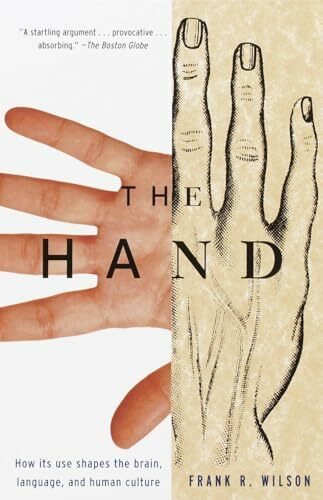
The Hand: How Its Use Shapes the Brain, Language, and Human Culture
Kurzinformation


 Handgeprüfte Gebrauchtware
 Schnelle Lieferung
 Faire Preise
inkl. MwSt. Versandinformationen
Artikel zZt. nicht lieferbar
Artikel zZt. nicht lieferbar

Beschreibung
„The Hand: How Its Use Shapes the Brain, Language, and Human Culture“ von Frank R. Wilson ist ein faszinierendes Sachbuch, das die entscheidende Rolle der menschlichen Hand in der Evolution und Entwicklung des Menschen untersucht. Wilson argumentiert, dass die Hand nicht nur ein Werkzeug für physische Aufgaben ist, sondern auch maßgeblich zur kognitiven Entwicklung beigetragen hat. Durch die Erkundung verschiedener Disziplinen wie Neurowissenschaften, Anthropologie und Linguistik zeigt er auf, wie die manuelle Geschicklichkeit die Struktur des Gehirns beeinflusst und somit Sprache und Kultur geformt hat. Das Buch bietet eine umfassende Analyse darüber, wie eng motorische Fähigkeiten mit kreativen und intellektuellen Prozessen verbunden sind und regt zum Nachdenken über die Bedeutung der Hand für unsere Identität als Menschen an.
Produktdetails

So garantieren wir Dir zu jeder Zeit Premiumqualität.

![Die Hand - Werkzeug des Geistes: [Mit Beiträgen von Eckhard Altenmüller, Niels Birbaumer, Maike Christadler, Bettina Handel, Peter Janich, Friedhart ... Ritter, Stephanie Töpfner, Thomas Wägenbaur]](https://d3k2uuz9r025mk.cloudfront.net/media/image/73/63/84/1786518633_687343797195.jpg "Die Hand - Werkzeug des Geistes: [Mit Beiträgen von Eckhard Altenmüller, Niels Birbaumer, Maike Christadler, Bettina Handel, Peter Janich, Friedhart ......")


![Handbook of Communication Disorders: Theoretical, Empirical, and Applied Linguistic Perspectives (Handbooks of Applied Linguistics [HAL], 15)](https://d3k2uuz9r025mk.cloudfront.net/media/image/78/bd/6c/1790762011_550363537447.jpg "Handbook of Communication Disorders: Theoretical, Empirical, and Applied Linguistic Perspectives (Handbooks of Applied Linguistics [HAL], 15)")


